


It is said that the first automobile headlights were household portable lamps. In 1887, when a driver got lost in a dark field, a farmer led him home with a lantern. In 1898, the Columbia electric car used electricity for its headlights and taillights, and thus the headlights were born. The original headlights could not be dimmed, so they were a bit dazzling when meeting cars. In order to overcome this shortcoming, an additional light adjustment was adopted later. This type of headlight can be moved in the vertical direction, but the driver must get out of the car to move the clamping device. It has been almost 120 years from the early acetylene gas headlights to today's free-surface reflector gas discharge headlights, and the evolution process is as follows: The first generation - acetylene gas headlights headlights with high contour brightness , The brightness of the acetylene flame is twice as bright as that of the electric light source at that time. Therefore, the automobile headlights used before 1925 are almost all acetylene headlights. The second generation -- electric light source headlights In 1913, the gas-filled incandescent bulb with a spiral filament came out. Because of its high brightness, it opened up broad prospects for electric light source headlights. However, due to the constraints of the automotive electrical equipment system at that time, electric lighting was not widely used until 1925. The third generation -- dual-beam wick headlights equipped with electric headlights with high-contour brightness gas-filled bulbs. Serious problem with traffic accidents and crashes. Therefore, two incompatible requirements are put forward for the design of headlights: one is how to make the road and obstacles with a height of at least 2-2.5m well illuminated within a distance of not less than 100m; the other is How to keep oncoming traffic drivers from being dazzled. The glare problem when cars pass by is still the most difficult problem to solve in automotive lighting technology. In order to solve the problem of dazzling cars, in 1924, after the double-light wick headlight was invented in Europe, the headlight with double-filament bulbs also appeared in the United States. However, the optical system structure principles of headlamps with non-dazzling low beams are different in Europe and the United States. The difference of the bulb lies in the shape and position of the filament; the difference of the light distribution mirror lies in the pattern and calculation of the refraction unit, so the light distribution of the low beam is also different. The low beam system is divided into two types: the European system and the American system. The coordination of the two systems is one of the major issues in the development of automotive lighting in the world today. The fourth generation -- asymmetric low-beam headlights The dual-beam wick headlight system is a symmetrical low-beam system. However, when the driving light (high beam) changes to the passing light (low beam), the viewing distance is shortened, forcing the speed to be reduced. In order to solve the problem of not dazzling the headlights and ensuring good illumination of the road during the meeting, the asymmetrical headlights were invented in the United States in 1932, which divide the beam into two parts centered on the reference axis. Second, the landing distance on the side close to the oncoming vehicle is short (that is, the beam is lowered to prevent glare), while the landing distance of the beam on the other side is long (that is, the beam is raised to increase visibility). The fifth generation -- h4 halogen tungsten headlights The first batch of automobile headlights equipped with halogen tungsten bulbs was produced by the French "Spey" company in 1964. The filament allowed to work at a higher temperature than ordinary incandescent bulbs. The efficiency is increased by about 50%, and the life span is also doubled. The sixth generation -- hid headlights The modern car headlights represented by hid headlights have undergone a series of major changes in light-emitting principles, structural forms, and manufacturing materials. hid xenon headlights emit light by ionizing inert gas through high voltage breakdown. The illuminance produced by it is strong, the color temperature is high, the penetrating power is strong, and it saves electric energy. It is an ideal light source for automobile headlights. The seventh generation—led headlights The latest research results in the United States show that in the next five years, white light high-power LED technology will largely replace various current lighting products, and will be suitable for various lighting of automobiles, including: headlights ] Brake lights, fog lights, emergency lights, interior lighting, etc. LED has many advantages such as high safety, stable operation, power saving, long life, etc. It is a development trend of vehicle lighting in the future.
Popular Products

177 906 9504/177 906 9604 Inner Tail Light for Benz A-Class
On this page you can find inner tail light for Mercedes-Benz A-Class, OE numbers 177 906 9504 / 177 906 9604,...
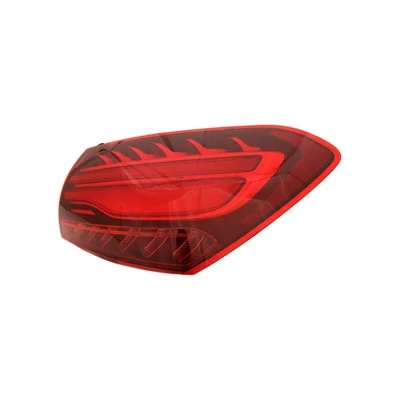
177 906 8704/177 906 8804 Outer Tail Light for Benz A-Class
This page is focused on outer tail light for Mercedes-Benz A-Class, OE numbers 177 906 8704 / 177 906 8804, built as...
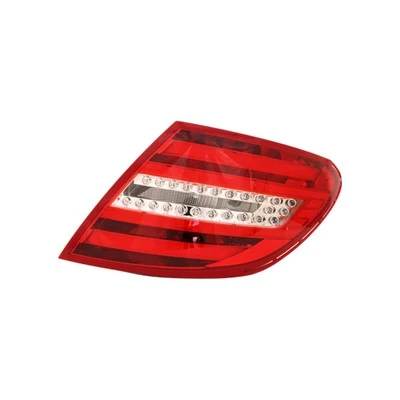
204 906 0203/204 906 0503 Tail Light for Benz C-Class 2011-2014
The displayed item is tail light for Mercedes-Benz C-Class 2011-2014, OE numbers 204 906 0203 / 204 906 0503,...

212 906 1503/212 906 1603 Inner Tail Light for Benz E-Class 2013-2015
This page is focused on inner tail light for Mercedes-Benz E-Class 2013-2015, OE numbers 212 906 1503 / 212 906...
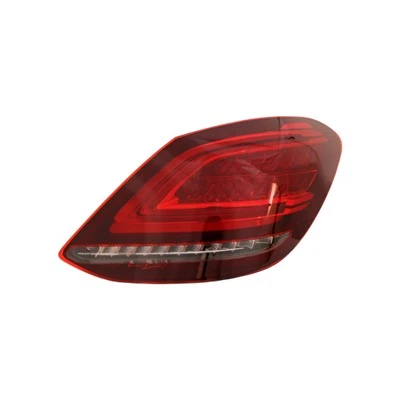
205 906 7103/205 906 7203 Tail Light for Benz C-Class 2019-2021
This page displays the tail light for Mercedes-Benz C-Class 2019-2021, OE numbers 205 906 7103 / 205 906 7203. It is...

212 906 1303/212 906 1403 Outer Tail Light for Benz E-Class 2013-2015
This listing introduces the outer tail light for Mercedes-Benz E-Class 2013-2015, OE numbers 212 906 1303 / 212 906...